
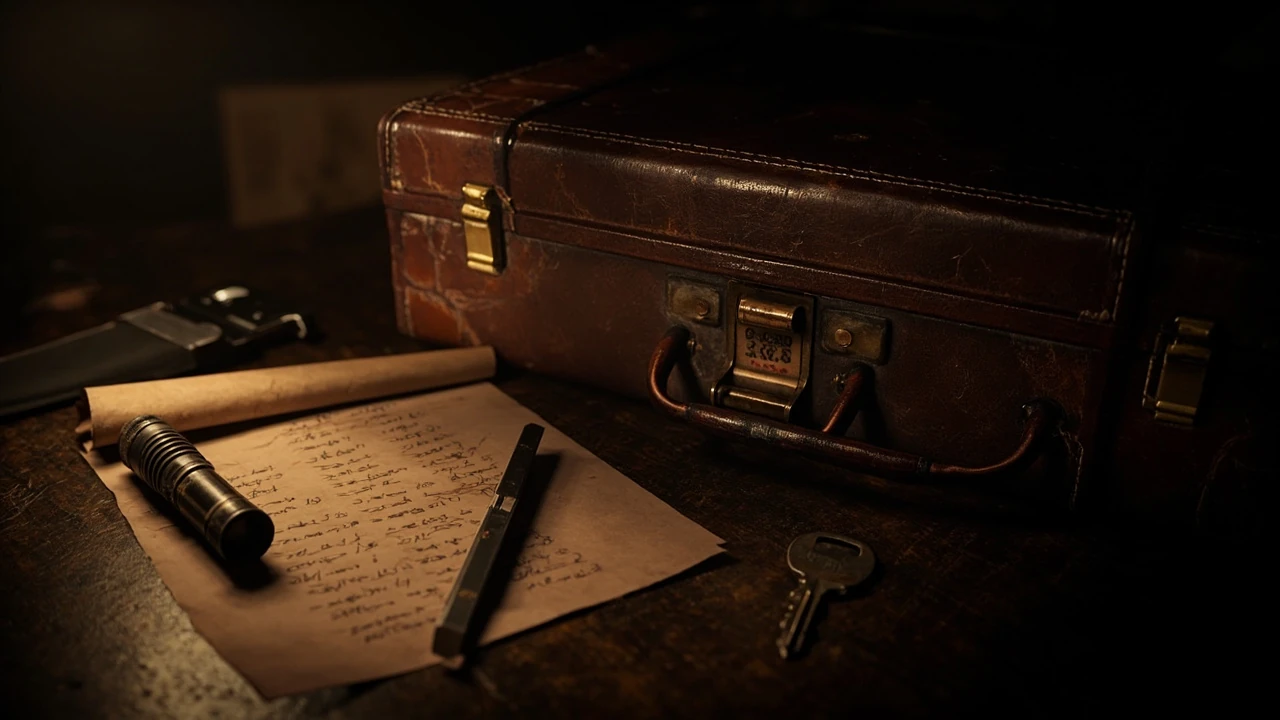
Briefcase code re9: what the lock puzzle actually represents
Players searching for a briefcase code re9 are usually stuck in front of a single locked briefcase inside a crime-scene apartment, trying to decide whether the answer is hiding inside a document they have already picked up, on a number painted on the wall, or in a code they simply walked past. In Resident Evil Requiem, the briefcase is not a generic safe, and the digits are not handed to the player on screen. The lock is a small environmental puzzle that asks the player to read a specific in-game file the way a detective would read a case report: by cross-referencing one number against a second clue that only registers when the player is actually paying attention to the apartment around the case.
That distinction matters for any guide. A walkthrough that simply prints the digits tells the player nothing about the design. A description that frames the briefcase as a standard combination safe is wrong by category, because the lock is staged like evidence rather than like a vault. The rest of this article treats the briefcase as a design object: what the lock is, where its digits come from, how the puzzle is meant to be solved without a guide, how it compares with the safe mechanics in earlier Resident Evil entries, what players should check when the digits they have do not seem to work, and how the puzzle ties into the rest of Requiem’s investigation loop.
What the briefcase actually is in Resident Evil Requiem
The briefcase in Resident Evil Requiem is a small investigation prop. Visually it is a battered leather case with a three-wheel combination lock and a single red indicator mark. Mechanically it is a one-shot container: opening it once empties the briefcase, and the lock stays in its final state for the rest of the playthrough. There is no reset, no second reward, and no randomized reroll between saves. Once the player knows the three digits, opening it is a matter of rotating the wheels to match the indicator and triggering the unlock prompt at the case itself.
The briefcase belongs to a broader category of lock puzzles that the series has used for two decades. Resident Evil 2’s typewriter-and-safety-deposit system, Resident Evil 4’s attaché case combination locks, Resident Evil 7’s cassette-tape cipher, and Resident Evil Village’s five-dial safe are all instances of the same family. What changes each time is the source of the digits, the format of the lock, and the way the player is expected to discover the combination. In Requiem the briefcase is a stripped-down version of that family: a single lock, three digits, one source of truth, and a short loop of reading and checking. Nothing about the prop is meant to feel like a vault, and that restraint is the point.
Where the briefcase code actually comes from
The digits for the briefcase are not arbitrary. They are drawn from a single physical document inside the same apartment the briefcase sits in. The player can find a case file, a printed report, or a hand-marked note that lists the numbers in a non-obvious way. The presentation is deliberately indirect, which is the entire point of the puzzle. A player who only skims the file will believe the document is flavor text. A player who reads every line will catch a date, a room number, or a reference to a piece of evidence that lines up with the lock on the case.
Players often describe the source as “hidden in plain sight” because the document does not look like a code at first glance. The three digits are usually presented as part of a longer numerical string, a partial date, a unit number, or a coded reference inside a paragraph of case notes. The puzzle, then, is not the lock itself but the act of reading. This is consistent with how Capcom has framed recent Resident Evil investigations: the answer is rarely a wall-mounted safe dial and is usually a piece of paper the player already walked past on the way to the briefcase.
The choice of a single source is also deliberate. Older Resident Evil entries often built puzzles around two or three clues that the player had to combine. Requiem collapses that structure into one document and a small amount of environmental reinforcement. That decision shrinks the puzzle but raises the cost of careless reading, because there is no second clue to compensate if the player misreads the first.
How the lock is designed to be solved without a guide
The intended solve path follows a short loop rather than a brute-force sequence. The player enters the apartment, sees the briefcase, reads the room for documents, finds a candidate file, and then tests whether any number in that file matches the lock. The loop is short on purpose. Resident Evil Requiem does not require the player to leave the apartment, return later with a different item, or chain multiple rooms together to reach the answer. The briefcase is a self-contained puzzle that the game expects a careful player to finish in a single sitting, ideally within a few minutes of finding the case.
The design also leans on environmental reinforcement. Walls in the apartment carry a small number of three-digit references: a date on a calendar, a time on a clock face, a tag on a piece of evidence, or a marked line in a notebook. Each of those is a potential distractor. A player who treats the document as the primary source and the wall as a cross-check is the player the design is aimed at. A player who treats the wall as primary and the document as flavor will often spend several minutes convinced the code is wrong before realizing the order of the digits, not the digits themselves, is the actual source.
None of this requires a particular build, weapon, or upgrade. The briefcase sits in a low-traffic room, the documents around it are visible from the doorway, and there is no combat scripted to interrupt the reading. The puzzle is built for the player who slows down rather than the player who moves quickly through the apartment, and that bias toward slowness is the design lesson Requiem’s investigation system is teaching from the first hour of the campaign.
Why the puzzle uses a lock instead of a key
A key would have moved the briefcase out of the investigative frame. Keys are objects the player carries, and once a key is found, the lock is solved mechanically. A combination lock instead forces the player to interact with information, which is the design lesson the series has been refining since Resident Evil 7. Requiem’s briefcase sits inside that lineage: it is a piece of evidence the player can read, not an obstacle the player can pick or force.
The combination lock also has production advantages. It is cheap to author, easy to localize, and resilient to translation issues. A picture of a three-digit number on a piece of paper does not need voice acting, animated text, or a language-specific string. The puzzle can be ported to any region with a single re-render of the document image and a numerical change if the team ever wants to regionalize the digits. That is part of the reason this style of puzzle keeps returning in Resident Evil: it is both narratively appropriate and operationally cheap, which is the kind of trade-off a long-running series tends to standardize on.
How the briefcase compares with earlier Resident Evil safe and lock puzzles
| Game | Lock type | Source of the code | Discovery method | Reward |
|---|---|---|---|---|
| Resident Evil 2 (2019) | Three-dial safe | Police station memos and computer files | Read scattered documents, cross-reference with a notebook | Weapon part, attachment, or key item |
| Resident Evil 3 (2020) | Two-dial lockbox | Hospital staff files and a calendar | Locate a single document and read the digits directly | First aid spray, ammo, or a hip pouch |
| Resident Evil 4 (2023) | Three-dial attaché case | Merchant sign, vendor note, or hidden plaque | Look for environmental decoration in the same room | Spinel, resource token, or treasure |
| Resident Evil 7 | Three-dial lock | Cassette tape with a verbal cipher | Listen to a tape, decode a phrase into digits | Weapon upgrade or ammo cache |
| Resident Evil Village | Five-dial safe | Phone call or written note with digits and a phrase | Pair a written number with a phrase that names the order | Crystal torso, treasure, or upgrade token |
| Resident Evil Requiem | Three-dial briefcase | Single case file in the same apartment | Read the file carefully and identify the relevant number | Single story-significant reward |
Requiem’s briefcase is a deliberate simplification when placed next to that history. It strips out the cassette-decode step of Resident Evil 7 and the phrase-pairing step of Village and replaces both with a focused reading task on one document. The result is a puzzle that is faster to solve, easier to design around, and harder to stumble into by accident, because there is no second system to mask a misread digit.
That simplification also tightens the relationship between prop and reward. Village’s five-dial safe and RE4’s attaché case usually gate a meaningful equipment upgrade, which justifies the longer chain of clues. Requiem’s briefcase gates a single narrative item, which justifies a shorter chain. The lock is scaled to the loot, and the loot is scaled to the lock, and that balance is what makes the puzzle feel proportionate rather than padded.
Common reasons the code does not seem to work
When the digits a player has do not unlock the briefcase, the cause is almost always one of a small set of issues. Working through this list in order usually resolves the problem without leaving the apartment.
- The player is using the digits in the wrong order. The document often lists a longer number, and the three relevant digits are not always the first three on the page.
- The player is reading a different document. Several files in the apartment contain numbers, but only one is the source for the briefcase, and it is not always the most prominent file on the table.
- The player has misread a handwritten digit. The 7s, 1s, and 4s in case files blur under the apartment’s low-light conditions, especially on the smaller monitors the game targets on handheld mode.
- The player is trying to use a value from a wall, a clock, or a calendar. Those are environmental reinforcement, not the primary source, and they will line up with the document at most on two of the three digits.
- The player has the right digits but is rotating the wrong direction past zero. The lock accepts digits in either direction, but the indicator mark must be aligned precisely with the engraved tick on the case.
For most players the first two items are the cause. The document with the right digits is usually not the most prominent file in the room, and the file with the most visible numbers is usually not the source, which is part of the design. The briefcase is built to reward the player who reads everything, not the player who reads the first thing they see.
What is inside the briefcase
The reward for solving the puzzle is intentionally modest. The briefcase is not a hidden cache of rare ammunition or a high-tier weapon. It holds a single item that is significant to the apartment’s story rather than to the player’s combat loadout. That choice fits the rest of Requiem’s pacing, because the game distributes upgrade resources across many small exploration rewards, and the briefcase is one of those rather than a centerpiece. Players solving it for pure mechanical gain will be underwhelmed. Players solving it for narrative coherence will find that the reward reframes a small piece of the apartment’s story and quietly changes the way a later scene reads.
This is also the reason the puzzle is short. A longer combination or a multi-step chain would have implied a more substantial mechanical reward, and the design team clearly did not want the briefcase to overshadow the bigger set-pieces in the same chapter. A three-digit lock with a one-document solution matches the weight of a single story item, which is the design contract the briefcase is built to honor, and it is the reason the puzzle never escalates into a multi-room scavenger hunt.
How the puzzle fits Resident Evil Requiem’s investigation loop
Requiem leans harder than its predecessors on the idea that the player is reading a case rather than fighting through a mansion. The briefcase is a clean example of that shift. The puzzle is staged like evidence: a physical prop, a single relevant document, and a short loop of reading and checking. There is no combat around the lock, no time pressure, and no resource cost for taking the time to read carefully. Even the lighting in the apartment is staged so the documents are legible without burning a flashlight, which is a small but deliberate concession to a player who is being asked to slow down.
That staging also teaches the player how the rest of the game expects them to behave. The same reading habits that solve the briefcase are the reading habits the rest of Requiem’s puzzles assume the player has already picked up. Players who skip the document and brute-force the lock will find later puzzles harder than they need to be, because the next set of investigations all reward the same habit of attention. The briefcase is, in effect, a tutorial disguised as a locked case, and the design is honest about that role by keeping the reward small and the loop short.
It also matters that the briefcase is the kind of puzzle a player can finish without inventory management. There is no consumable, no crafting component, and no key item to spend. The only resource the puzzle asks for is time, and the only failure state is impatience. That is a different shape of challenge from the combat encounters in the same chapter, and the contrast is part of how the chapter’s pacing holds together.
What the briefcase is not
A few clarifications help prevent bad guidance from spreading. The briefcase is not part of a larger in-game safe network, and opening it does not unlock any related container in the same apartment or the next. The digits are not entered in a menu screen; the player rotates a physical dial on the case itself. The briefcase is not tied to a difficulty setting, and it does not behave differently on a second playthrough within the same save file. The puzzle also is not randomized. The digits on the document and the order in which the player reads them determine the answer, and that answer is fixed across regions and platforms.
It is also worth noting that the briefcase is not a meta-puzzle, in the sense that no external Capcom announcement, livestream, or marketing material carries the digits. The answer lives entirely inside the apartment, which is part of why players who wander out of the room looking for help are usually the ones who end up searching for a written solution online. The briefcase is designed to be solved in the room where it sits, and any guidance that points outside that room is missing the point of the design.
How to confirm the digits before touching the lock
Before rotating the wheels, a player who wants to be sure has a small set of validation steps. None of them require leaving the apartment or consulting outside sources.
- Re-read the candidate document end to end and underline every number that appears, including dates, room numbers, and reference codes.
- Check whether the underlined numbers include a three-digit group whose digits fall in a plausible range for a combination lock, and whether that group is visually separated from the surrounding text.
- Compare the three digits against the apartment’s environmental numbers. A repeated number across the document and the room is a strong signal that the document is the source.
- Confirm the order of the digits using the document’s own layout. The first digit usually appears closest to the top of the page, and the last appears closest to the signature, footer, or stamp.
- Test the order on the lock. If the case does not open, reverse the digit order before assuming the code is wrong, because reversal is the most common cause of a failed first attempt.
This is the same approach the rest of Resident Evil Requiem’s investigation design assumes. The game rarely offers a single source of truth and instead asks the player to triangulate from a small set of weak signals, and the briefcase is the cleanest example of that habit in the first act.
What to do if a guide disagrees with what you see in the apartment
Players sometimes open a guide expecting the digits to appear exactly as written in the document and find that the document they have shows a different number. That mismatch is usually a sign that the guide is wrong about which document is the source, not that the game is wrong. Resident Evil Requiem has several documents in the apartment that contain numbers, and the briefcase is wired to only one of them, so a guide that points at a different file will give digits that match that file rather than the lock.
If the document the guide is referring to is missing from the apartment, the most common explanation is that the player has already picked it up and stored it in the inventory. Reading it again from the inventory will show the same numbers in the same place, because the document is not edited once it has been collected. If the document is still on the table but the numbers are different, the player is looking at the wrong file. The puzzle expects a single source, and the source is not the file with the most visible numbers, which is the trap that catches most first-time players.
It also helps to ignore screenshots that show the lock in the unlocked position. Some guides crop the document in a way that hides surrounding text, which can make the relevant three-digit group look like the only number on the page. In the actual game, the relevant group is almost always one of several numbers on the document, and the layout of the page is the only reliable hint about which group is the source.
Why this puzzle is worth solving even on a replay
On a second playthrough the briefcase becomes a small design study. The player already knows the answer, so the loop of discovery collapses, but the loop of reading does not. The same apartment is still staged as a case scene, and the same documents still carry the same information. A player returning to the puzzle with full knowledge of the answer can now watch the design itself: which document the game chose, how it framed the digits, what it kept as misdirection, which environmental numbers it placed to act as cross-checks, and which files it left in the room purely to waste a careless reader’s time.
That replay value is one of the reasons the Resident Evil series keeps returning to the same basic lock format. Each entry adds a small variation, and the variation is exactly the kind of thing a careful player will notice the second time through. Requiem’s contribution is the single-source document and the tight loop around it. A player who has finished the game can sit with the apartment for ten minutes and see why the design chose that file and not another, and that observation tends to make the rest of the campaign’s puzzles feel more deliberate on a second run.
What the briefcase teaches about reading the rest of the apartment
The briefcase is also a calibration point for the rest of the apartment. The same room contains a small cluster of objects that look like clues but are not: a clock set to a specific time, a calendar pinned to a particular month, a piece of evidence tagged with a case number. None of those by themselves unlock the case, and the design uses them to set up a habit. The habit is to read first, trust second, and only then rotate the dial, and the briefcase is the moment in the chapter where that habit gets reinforced before the player walks into the next set of rooms.
That habit also explains why the briefcase is placed where it is. The apartment is one of the first places in the campaign where the player is allowed to stand still without punishment, and the briefcase is the one locked object the player can fully solve in that window. By the time the player leaves the apartment, the game has already taught the reading habit it will rely on for the rest of the act, and the briefcase is the small object that does the teaching.
How the briefcase compares with other single-document puzzles in the genre
| Game | Puzzle type | Source of the answer | Misleading extras in the room | Puzzle length |
|---|---|---|---|---|
| Resident Evil Requiem | Three-dial briefcase | Single case file in the same apartment | Clock, calendar, evidence tag, and a second numbered file | Two to five minutes for a careful player |
| Alan Wake 2 | Word-based safe | Single manuscript page with a coded word | Photographs, posters, and radio fragments | Three to six minutes |
| The Medium | Four-digit lock | One journal page with a date and a code | Family photos, voicemail logs, and a second journal | Three to seven minutes |
| Silent Hill 2 (2024) | Three-dial combination pad | One letter with a partial address and a number | Newspaper clippings, flyers, and a map | Two to four minutes |
| Tormented Souls 2 | Two-dial padlock | One memo with a reference number | Lab charts, sticky notes, and a clipboard | One to three minutes |
Placed next to its peers, Requiem’s briefcase is on the shorter end of the scale. It asks for less reading than Alan Wake 2’s word puzzle, less triangulation than The Medium’s journal page, and less environmental scanning than Silent Hill 2’s combination pad. What it gives up in length it gains in focus, because the room is small enough that the player can finish the puzzle without leaving the line of sight of the case. That focus is the design choice that separates Requiem’s briefcase from the longer scavenger hunts in the same genre.
Frequently asked questions
What is the briefcase code re9 actually for?
The briefcase code in Resident Evil Requiem opens a single leather case inside an apartment. It is a self-contained investigation puzzle with a fixed three-digit answer drawn from one case file in the same room, and opening it grants a single story-significant item rather than a major resource.
Where do the briefcase digits come from?
The digits are written into a single physical document inside the apartment. Other files in the room contain numbers, but only one document is the source for the lock. The relevant number is usually part of a longer string and has to be read carefully to identify the right three digits.
Is the briefcase code randomized between playthroughs?
No. The digits are fixed for the apartment, and the answer does not change between saves or new playthroughs. The puzzle relies on reading rather than on randomized lock behavior, and the document is identical across regions and platforms.
Can the briefcase be opened without reading the document?
No. The lock is a three-dial combination without a key bypass, and the digits are not displayed on the lock itself. A player who skips the document will need an outside source to solve the puzzle, because the apartment does not offer a second system that hands the answer to the player.
Why do some players report different digits for the same apartment?
Most of the time the disagreement is about which document is the source. The apartment contains several files with numbers, but the briefcase is wired to only one of them. A guide that points at a different file will give digits that match that file rather than the lock, which is why screenshots from different players often look inconsistent.
Does the order of the digits matter?
Yes. The lock accepts digits in a specific order, and reversing the order is the most common reason a correct set of digits fails to open the case. The document’s own layout usually determines the order, with the first digit closest to the top of the page and the last closest to the signature or stamp.
What is the reward for opening the briefcase?
The reward is a single story-significant item that reframes a small piece of the apartment’s case. It is not a major resource, weapon, or upgrade. The puzzle is built to match the weight of that reward, which is why the lock uses a short combination rather than a longer chain.
Does the briefcase reset after opening?
No. The briefcase is a one-shot container, and the lock stays in its final state for the rest of the playthrough. There is no second reward and no randomized reroll, and the case cannot be re-closed to be solved a second time on the same save.
Is the briefcase puzzle tied to a difficulty setting?
No. The lock behavior, the document, and the reward are the same on every difficulty. Changing the difficulty does not change which file the briefcase reads or which digits it expects, and the puzzle does not scale in either direction.
Should I solve the briefcase on a first playthrough?
Yes. The puzzle is short, the reading habit it teaches carries into the rest of Resident Evil Requiem, and the reward is part of the apartment’s story rather than an optional side collectible. Skipping it is a small loss in loot and a larger loss in pacing, because the chapter assumes the player has already built the reading habit by the time they leave the apartment.
What happens if I pick up the source document by accident?
The document is stored in the inventory and can be re-read at any time. The numbers on the page do not change once the file has been collected, so the player can still solve the briefcase after picking the document up, and the document can also be dropped back into the room if the player wants to read it next to the case.
Does the briefcase have any connection to the apartment’s other locked containers?
No. The briefcase is the only locked container in the apartment that is wired to a single case file. Other drawers and cabinets in the same room are opened with keys or with no lock at all, and the briefcase does not share its combination with any of them.


Leave a Reply