Blue Lock Rivals: what the experience actually is and who it serves
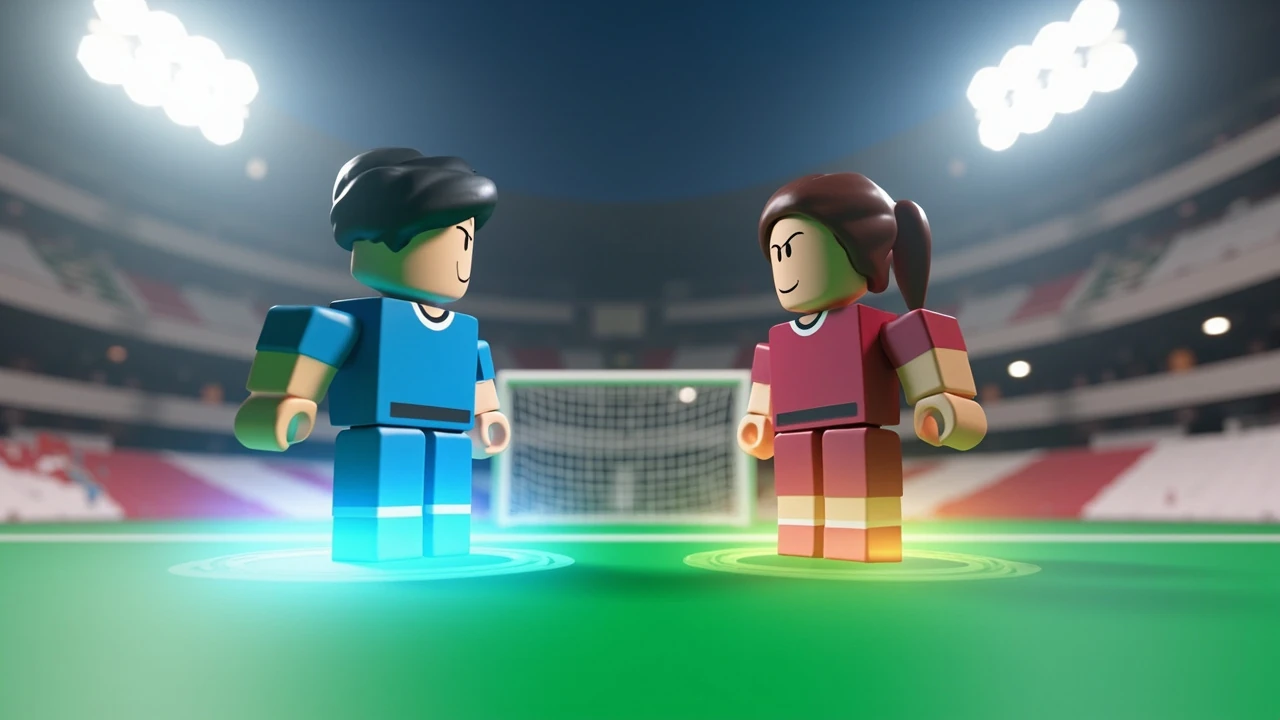
Blue Lock Rivals is a fan-made soccer combat game on Roblox that borrows its visual identity, character roster, and stylization from the Blue Lock anime and manga. The core loop is short: two players enter a stylized arena, the ball drops, and the match is decided by timing, ability selection, and stat-driven performance. In practice the experience sits at the intersection of a fighting game, a sports sim, and an anime gacha, which makes it interesting both as a player product and as a development case study for anyone working on Roblox.
For players, the usual question is whether the game is worth the time investment compared with other anime-themed Roblox titles such as Anime Fighters, Anime Defenders, or the many Bleach and Naruto experiences that sit on the same store page. For Roblox developers and technical artists, the question is more about how the team is using the platform’s character engine, ability systems, and live-ops pipeline to keep a fast-moving anime IP fresh without running into Roblox’s moderation policies. This guide covers both angles, with a heavier focus on the engineering and design side because that is the part that general player coverage tends to skip.
Why Blue Lock Rivals fits inside a GameDev editorial
A Roblox title named after a third-party anime looks like a player-only topic from the outside, but it actually touches on several production disciplines that GameDev readers work in every day. The development team has to negotiate licensing boundaries, schedule content drops around anime broadcast calendars, balance a roster of characters with distinct abilities, and ship updates that feel responsive without corrupting save data. The result is a useful case study for anyone working on licensed, fast-iteration multiplayer games, especially on a platform where the engine, the store, the social graph, and the moderation policy are all owned by the same company.
This article focuses on the parts that a GameDev reader can evaluate honestly: the engine category, the gameplay loop, the social systems, the live update cadence, and the design trade-offs that show up in community discussion. Where a claim depends on what an official source has said, that source is named. Where a claim is community observation, it is labeled as such, because the gap between developer intent and player perception is often where the most useful lessons live.
Game engine and platform: what powers Blue Lock Rivals
Blue Lock Rivals is built on Roblox Studio and runs on the Roblox client. Roblox Studio is not a single engine in the Unreal or Unity sense; it is a tightly integrated editor, asset pipeline, and runtime that uses Lua or Luau for scripting. Most competitive games on the platform, including Blue Lock Rivals, rely on the same character framework that the Roblox Animation Editor exposes, paired with a custom ability layer that handles stats, cooldowns, and damage windows. The studio behind the game does not own the engine; it owns the design and the scripts, which is a different kind of production risk from a standalone PC or mobile title.
From a developer’s perspective, three technical layers are worth understanding in detail:
- Character and rig layer. Roblox’s humanoid rig gives every avatar a shared skeleton, which is why so many Roblox titles can ship in weeks rather than years. Blue Lock Rivals leans on this rig to apply anime-specific clothing, hair meshes, and animation packs without rebuilding a skeleton per character. The trade-off is that any character that needs an unusual rig, such as a goalkeeper with extra arms or a character whose silhouette has to read at long range, is harder to ship cleanly than a standard humanoid.
- Stat and ability layer. Game-specific stats such as shoot power, sprint speed, and dribble control are stored on the server and replicated to the client. This is where most of the balance work happens, and it is the part of the codebase that changes with every patch. Designers can ship a balance change without touching art, and that is the main reason Roblox competitive titles can iterate at a pace that would be unusual for a console game.
- Network and match layer. Each match is essentially a small instanced server. Authority over damage, goals, and ability activation is server-side, which prevents the most common forms of trivial cheating but does not eliminate visual desync on poor connections. The studio has to choose how aggressively it interpolates position and ability state, and that choice shows up in how the game feels on mobile data versus fiber.
For comparison, the broader Anime Fighting X genre of Roblox titles, which includes the popular Blue Lock-adjacent experiences, all sit on this same stack. Differences between them usually come down to which studio has the strongest ability scripting team, which team has the most disciplined art pipeline, and which team has the cleanest moderation response, not which engine they use. The engine is constant; the execution is the variable.
Gameplay loop: how a typical match flows
Blue Lock Rivals follows a recognizable rhythm that fans of the genre will recognize from the first match. The match starts with a kickoff animation, the ball is contested in the midfield, and a goal ends the round. The unique layer is the ability system: each character has access to a primary shoot, a secondary dribble or steal, and an ultimate that can be charged during play. Choosing the right ability at the right moment is usually what separates a win from a loss, and the time window in which that decision has to be made is short.
A simplified version of the loop looks like this:
- Queue or invite. Players enter a 1v1 or small-sided match through a matchmaking menu. Queue times vary with population and any active event boost, and the studio can shorten queues with double rewards without touching the gameplay code.
- Character select. The player chooses from the currently unlocked roster. Some characters are gated by a Luck-based pull, others by progression or by an active pass, and a small number are given out for free during seasonal events to keep the free-to-play curve from collapsing.
- Kickoff and contest. The ball is served into the arena, and both players attempt to establish control using positioning, sprint timing, and an early ability. The first three seconds of a match are where most casual players lose ground, because the meta rewards players who already have their input mapped.
- Build and release. Energy builds passively as the player performs offensive actions such as shots, dribbles past an opponent, and successful steals. A charged ultimate usually changes the expected value of the next shot dramatically, and a well-timed ultimate can swing a round that was lost on paper.
- Resolve and reward. The match ends on a goal, a timeout, or a disconnect. Rewards are tallied server-side and credited to the player’s account, including experience toward the next pass level and a small amount of soft currency that is tuned per match length.
The loop is short, which is intentional. Short matches with strong visual feedback are how Roblox competitive titles keep retention numbers in a healthy range. Long sessions are built from many short matches rather than from a single sitting, and that design choice has consequences for monetization, because players who finish a match in 90 seconds are more willing to start another one than players who have just lost a 25-minute round.
Roster design and how characters are balanced
The roster in Blue Lock Rivals is built around recognizable Blue Lock characters, each mapped to a role that approximates their anime portrayal. Forwards tend to lean on shoot power, midfielders on stamina and dribble control, and defensive archetypes on tackle strength and reach. This is not a one-to-one translation of the manga, because some characters are more popular in the game than they are in the source material, and the studio has to adjust stats to match what players expect rather than what the anime actually shows.
Character balance is a continuous process. Whenever the studio ships a new patch, the community looks for two things: whether an existing top-tier character has been nerfed into irrelevance, and whether a previously weak character has crossed the line into overpowered. Both reactions are common, and both are useful signals for a developer audience because they show what kind of change the player base notices. A small stat change is often invisible; a small animation change is often treated as a complete rework, because the animation is the part of the character that the player sees on every input.
A simplified view of the design space is helpful:
| Archetype | Primary stat focus | Risk profile | Player skill demand |
|---|---|---|---|
| Power forward | Shoot power, aerial reach | High variance, high ceiling | Medium to high |
| Dribble specialist | Sprint speed, control | Depends on combo timing | High |
| Defensive wall | Tackle strength, reach | Lower offensive upside | Medium |
| All-rounder | Balanced stats | Few hard matchups | Low to medium |
| Ultimate carry | Charged ability scaling | Strong in long rallies | High |
None of these archetypes is strictly better than the others in a vacuum. Matchmaking quality, ping, and current patch notes tend to swing the value of each role week to week, which is part of why the game keeps returning players. The studio can also rotate which archetype is in the spotlight by tying event rewards to specific characters, which gives the design team a lever that does not require a balance patch to use.
Live operations: how updates, events, and codes are scheduled
Live operations is the part of Blue Lock Rivals that most players experience as the game changing overnight. New characters arrive in waves that loosely track the broadcast and streaming schedule of the Blue Lock anime, with the second season functioning as a useful reference point for when new character art and abilities might be expected to land. Codes are released alongside major events to reward returning players, and limited-time modes appear during school holiday windows when Roblox traffic is at its highest, because the platform’s daily active user count swings sharply with the school calendar.
From a producer’s perspective, the operational checklist is roughly the same every cycle, and the discipline is what separates the studios that retain players from the studios that lose them:
- Pre-event scoping. Decide which characters, modes, and cosmetics will be available during the event window. Lock the scope before art production starts so the patch can ship on time, because scope creep is the most common cause of missed dates on Roblox.
- Reward and economy tuning. Adjust drop rates, code rewards, and pass progression so that active players feel rewarded without flooding the economy. Soft currency inflation is a real risk on Roblox, and a studio that prints too much currency will see its pass lose perceived value within a single season.
- Regression check. Test the new abilities against the existing roster to confirm no combination trivializes the meta. The cheapest regression test is a small internal ladder, but the most useful one is a closed playtest with a handful of community players, because the community will find the broken combo on day one regardless.
- Comms and code drop. Publish the patch notes, queue the social posts, and release codes through the official channels at a coordinated time. A code that drops an hour before the patch notes is treated as a leak, and a leak trains players to look for leaks instead of reading patch notes.
- Post-event retro. Review retention curves, match length, and report volume to decide what carries into the next cycle. The retro is also where the studio decides whether a mode is worth keeping in the rotation or whether it should be retired to make room for the next idea.
Codes deserve a separate note because they are the most visible part of the live-ops machine. A code typically grants a small amount of in-game currency, a cosmetic, or a small stat boost, and the redemption window is short. Active players are rewarded for being online at the right moment, and lapsed players are nudged back by leaks on social channels. The studio knows that any code is public within minutes, and the design of the rewards reflects that, with cosmetic items usually weighted higher than raw currency so that the economy is not drained by code farms.
Player progression, passes, and the long-term hook
Progression in Blue Lock Rivals is built around three overlapping systems. The first is character unlocks, which are driven by a luck-based pull that costs soft currency. The second is a battle pass or season pass that levels up through play and grants cosmetics and currency at fixed intervals. The third is account level, which usually unlocks quality-of-life features such as extra loadout slots or training room access. Each system targets a different kind of player, and the overlap between them is the part of the design that is hardest to get right.
This layering is intentional, and each layer carries a specific risk that the design team has to manage. The pull system provides the gambling-adjacent dopamine that keeps free-to-play Roblox titles profitable, but it also creates the most vocal complaints when a new character feels locked behind a paywall. The pass system guarantees that even a player who pulls nothing of value still feels progression, but a pass with weak rewards can read as filler. Account level provides a slow, stable climb that survives across seasons and keeps a long-tail of players from feeling like their time has been wasted, but a grind that is too steep pushes players toward the unofficial Roblox trading scene rather than the official store.
A useful way to think about the trade-off is to compare the three systems side by side:
| System | Primary reward | Player cost | Risk for the developer |
|---|---|---|---|
| Character pull | New playable character | Soft currency, time | Whale dissatisfaction if rates feel unfair |
| Season pass | Cosmetics, currency, occasional characters | Play time, optional premium track | Pass fatigue if rewards feel low-effort |
| Account level | QoL features, prestige | Consistent play time | Grind complaints if curve is too steep |
The interesting design question is not whether these systems are present, because almost every Roblox competitor has them. The interesting question is how the studio tunes the rate of overlap between them, because too much overlap causes fatigue and too little causes the pass to feel disconnected from the core game. A pass that grants currency that is only useful for the pull that gates the characters the pass does not include is a pass that players will quietly stop buying.
Community dynamics and the social layer
Roblox is a social platform first, and Blue Lock Rivals inherits that reality. Clans, friend lists, party queues, and Discord links all sit on top of the matchmaking layer. The studio encourages this by rewarding group play with bonus experience, but it also has to moderate it because voice and chat in Roblox are subject to platform-wide safety rules that are stricter than what a standalone PC game would face. The same chat system that lets a clan coordinate a tournament also lets a stranger send a slur, and the studio has to plan for both.
A few community dynamics are worth naming for a developer audience because they shape the studio’s day-to-day priorities more than the patch notes do:
- Tier-list culture. Every new character triggers a wave of community tier lists within hours of release. These are not always accurate, but they are a strong signal about which characters feel rewarding to play, and a character that the community ranks at the top without the studio intending it is a balance signal that has to be addressed before the next patch.
- Code sharing. New codes spread through Discord and YouTube within minutes. The studio has to assume that any code is public from the moment it ships, which means that codes are designed as a small reward rather than as a primary progression path, and the most generous rewards are kept behind the pass instead of behind codes.
- Clip culture. Roblox clips and TikTok edits drive the discovery loop for younger players. A flashy new ultimate can outperform a balanced patch in raw signups, which is why the animation team has to ship a visually distinct ability with every new character even if the underlying stat block is conservative.
- Report and moderation pressure. Because the game is competitive, the report queue fills quickly after each patch. The team has to invest in moderation tooling or risk the platform stepping in, and a moderation takedown on Roblox can take a game off the front page overnight.
None of this is unique to Blue Lock Rivals, but the speed at which it happens in the Roblox ecosystem is faster than in most traditional PC or console titles, and it shapes the studio’s day-to-day priorities. A patch that would take two weeks of community discussion on a Steam forum takes two days on Roblox, and the team has to be ready to respond on the same timeline.
Design trade-offs worth flagging for GameDev readers
Several recurring trade-offs show up in community discussion and in any honest review of the game. They are worth naming because they generalize beyond this specific title, and a studio lead working on a different licensed Roblox game will run into the same trade-offs in a different costume.
Short matches versus skill expression. A short match length keeps queue times low, but it also limits the room for a player to recover from a slow start. A 90-second match with a 3-0 lead is functionally over, even if the studio would prefer a comeback mechanic. The honest fix is to design abilities that are useful when the player is behind, but the design space for that is small, and most Roblox competitive titles settle for short matches and accept the lost-comeback rate as a cost of fast queueing.
Luck-based unlocks versus competitive integrity. If a new character is meaningfully stronger than the rest of the roster, players who cannot unlock it feel locked out of the meta. If the new character is weaker, players who did unlock it feel cheated. The studio has to thread this needle every release cycle, and the easiest mistake is to ship a new character at full power and then nerf it, because the nerf reads as a bait-and-switch even when it is the right balance call.
Anime fidelity versus moderation risk. Stylized anime art is part of the appeal, but Roblox moderation rules apply to character art as well. The studio has to ensure that no character is interpreted as inappropriate, and that requires a careful review of every new skin and emote. A pose that reads as confident in a manga panel can read as suggestive on a Roblox avatar, and the art team has to design for the platform rather than for the source material.
Update cadence versus stability. Frequent updates keep the game fresh, but each patch risks introducing a new bug or balance problem. The team has to weigh the cost of shipping a smaller, safer patch against the cost of waiting and risking a longer content gap. The studios that handle this well tend to ship a small balance patch every week and a larger content patch every three to four weeks, with a hotfix channel reserved for genuine emergencies.
Licensed IP versus platform rules. Blue Lock is a third-party IP, and the studio does not own it. Any character, mode, or cosmetic that strays too far from the source material can create a licensing problem that is more serious than a balance problem, and the team has to keep a buffer between what the anime shows and what the game ships. The same constraint does not apply to an original-IP Roblox game, which is one of the reasons original IP tends to be more flexible on the platform even though it is harder to launch.
For a studio lead, the lesson is that licensed competitive Roblox games are not a set-it-and-forget-it product. They are an ongoing live-ops workload with the discipline of a mobile game and the budget of a small indie team, and the studios that survive are the ones that plan for that workload before the first patch, not after.
What the wider anime IP means for the game’s future
The Blue Lock anime has gone through several broadcast cycles, and each cycle has been a content event for the game. The second season is the most useful reference point for the kind of content the studio is likely to lean on, because it set the pattern of new character reveals, new visual motifs, and a new competitive storyline that the game can echo. Industry coverage of a possible third season gives the studio something to plan against, because a confirmed broadcast date is the single most reliable signal for when a new wave of players will arrive looking for the characters they just saw on screen.
From a planning perspective, the studio has to choose between two strategies. The first is to ship content that anticipates the next broadcast, so that the game has the new characters ready on day one of the anime’s release. The second is to wait for the broadcast and then ship a content patch in the weeks after, which is safer from a licensing perspective but risks losing the launch-week traffic to a competitor. Most Roblox anime games land somewhere in the middle, with a soft launch of teaser cosmetics in the weeks before the broadcast and a full character patch in the weeks after.
For a GameDev reader, the relevant point is that the game’s roadmap is shaped less by internal design preference and more by an external broadcast calendar that the studio does not control. That constraint is unusual outside of licensed games, and it is one of the reasons licensed Roblox titles tend to feel more reactive than original-IP Roblox titles, even when the underlying engine and tools are the same.
Practical takeaways for players and developers
For players, the practical takeaway is that Blue Lock Rivals rewards short, focused sessions and a small roster of characters that the player actually knows, rather than a large roster of characters that the player has unlocked but never practiced. The training room is the most underused feature in the game, and a player who spends twenty minutes in the training room before a ranked session will usually out-perform a player who has played twice as many matches without that warm-up.
For developers, the practical takeaways cluster around three areas. The first is engine leverage: the studio is renting a platform, not owning it, and every design decision has to account for the fact that Roblox can change the rules of the platform with a single policy update. The second is live-ops discipline: the studios that retain players are the ones that ship on a predictable cadence, communicate clearly when a ship slips, and avoid the temptation to over-correct balance in a single patch. The third is community tooling: report queues, code distribution, and clip-friendly animations are not polish, they are core systems, and the studios that treat them as core systems tend to keep their games on the front page longer than the studios that treat them as afterthoughts.
The honest summary is that Blue Lock Rivals is a useful case study because it shows what a small team can do on a constrained platform when the team is willing to commit to a fast iteration cycle and a clear content calendar. It is not a perfect game, and the trade-offs named above are real, but the trade-offs are also the point, because they are the trade-offs that any studio working on a licensed Roblox game is going to face.
Frequently asked questions
Is Blue Lock Rivals an official Blue Lock game?
No. Blue Lock Rivals is a fan-made experience built in Roblox Studio. It uses the Blue Lock brand and characters in a stylized way, but it is not produced or distributed by the official Blue Lock anime or manga licensors. The studio is a third-party developer, and the game operates under Roblox’s general fan-content rules rather than under a direct license from the IP holder.
What platform does Blue Lock Rivals run on?
Blue Lock Rivals runs on Roblox, which is available on PC, mobile, console clients that support Roblox, and supported VR headsets. Performance and control feel vary by platform, which is why competitive players usually prefer PC or a recent console where input latency is more predictable.
Do codes actually matter in Blue Lock Rivals?
Codes are useful but they are not the primary progression path. A code usually grants a small amount of in-game currency or a limited cosmetic, and the redemption window is short. Most long-term progression comes from playing matches and completing the season pass, and a player who only chases codes will fall behind a player who plays consistently.
How often does the game get new characters?
The roster is updated on a rolling basis, with new characters usually tied to anime broadcast milestones or seasonal events. The cadence varies, but players can generally expect new additions every few weeks, along with balance changes to the existing roster. The exact date of a new character is rarely announced more than a few days in advance.
Is Blue Lock Rivals pay-to-win?
It depends on the patch. Some updates have introduced characters that were meaningfully stronger than the existing roster, which can feel pay-to-win if those characters are gated behind a paid track. Other updates have been more conservative. The honest answer is that the balance shifts every patch, and players should treat community tier lists as a snapshot rather than a permanent ranking.
What should a Roblox developer learn from Blue Lock Rivals?
Three things stand out. First, a strong visual identity tied to a known IP drives discovery faster than a generic art style. Second, a layered progression system of pulls, pass, and account level keeps both casual and committed players engaged. Third, a fast live-ops cadence is essential, and the team that ships patches more reliably tends to win retention over the long term.
How does the game handle matchmaking?
Matchmaking is server-side and uses a combination of account level, recent win rate, and queue population. The exact formula is not public, but community observation suggests that queue times can spike during off-peak hours, especially for higher ranks, which is a common constraint in Roblox competitive titles where the player pool is smaller than in a flagship PC shooter.
Is Blue Lock Rivals appropriate for younger players?
The game is rated for Roblox’s general audience and avoids the most explicit content from the source material, but it is still a competitive online game with chat features. Parents should use Roblox’s built-in account controls to limit chat and to review the studio’s safety settings before letting younger players play.
What is the best way to get better at the game quickly?
Practice the timing of the most common abilities in the training room, learn one or two characters deeply instead of swapping constantly, and watch recent tournament clips to see how the current meta is being played. Improvement is much faster when the practice is targeted rather than when it is just queue grinding.
Will Blue Lock Rivals still be worth playing in a year?
That depends on the studio’s roadmap and on the continued broadcast of the Blue Lock anime. As long as new content is being shipped and the community remains active, the game has a reasonable chance of holding its audience. If updates stall, the competitive player base usually moves to the next anime-themed Roblox title quickly, and the cost of rebuilding a player base after a content drought is much higher than the cost of shipping a small content patch every month.

Leave a Reply