
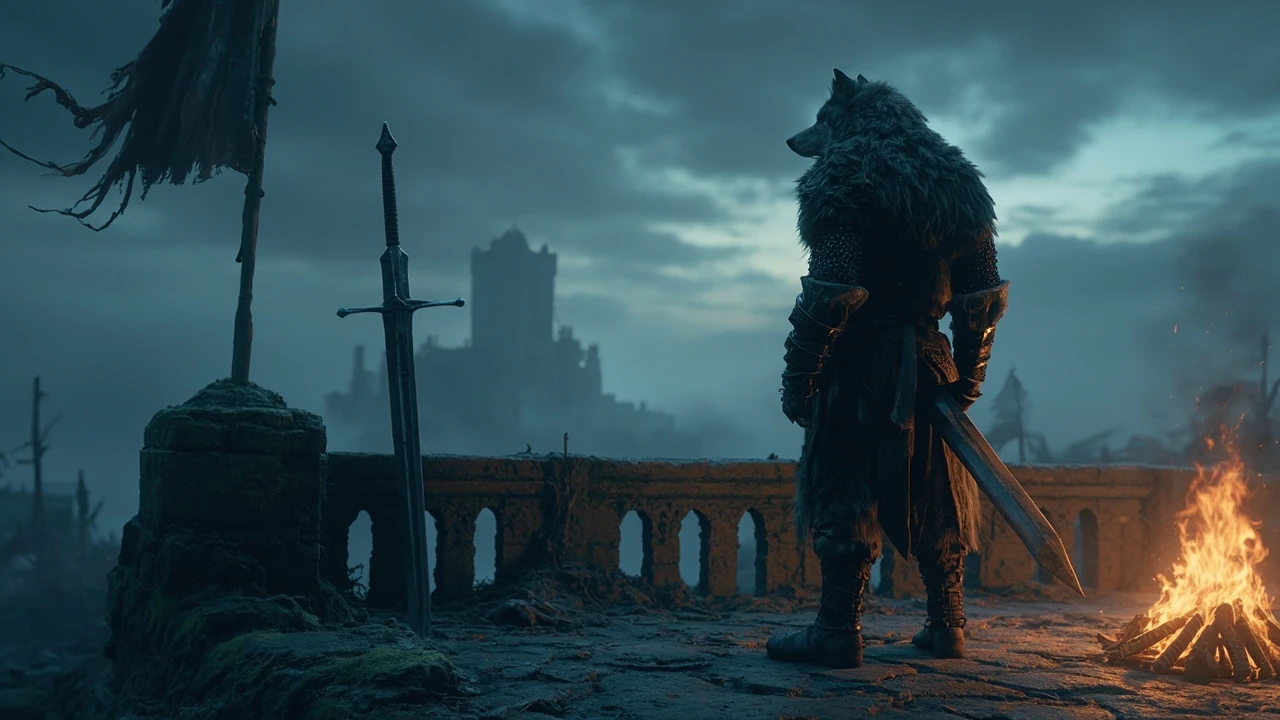
The blaidd questline in Elden Ring
Meeting a half-wolf warrior at the foot of a misted bridge is one of the stranger introductions in Elden Ring. He calls himself Blaidd, says he was sent to find a bearer of the guidance of grace, and immediately offers to help you storm a castle full of unwanted heirs from an old dynasty. Because the encounter happens almost the first time a new player leaves the starting plateau, many players either rush through his scenes or lose him entirely to a single missed trigger in a different region. This article treats the full blaidd questline as one connected chain: every meeting, every side character who can break or extend it, the fights that gate his personal story, and the two completely different endings that his loyalty produces.
Everything below is written for a single Tarnished who wants to see the complete arc on one character without consulting several sources to stitch it back together. Steps are listed in a practical order, but the text also explains the engine-style design reasons behind the quest’s branching, because the same design language shows up in other NPC questlines that share the open world. Expect heavy spoilers: the questline is impossible to finish correctly without making decisions you cannot undo on a single save.
Who Blaidd is and why his questline exists
Blaidd is a named NPC who first appears in the Limgrave region of Elden Ring, near the bridge that leads toward the Raya Lucaria legacy dungeon. Mechanically he functions as a summonable ally, a story beat, and a branching trigger. From a quest design perspective, he is a textbook example of FromSoftware’s “guidance of grace” pattern: an NPC whose role is to send the player into a specific legacy dungeon at a specific time, then reappear later when the player has grown strong enough to be useful again.
His identity is more interesting than his combat role. Through dialogue, item descriptions, and a late-game scene, the game reveals that Blaidd is a summoned being bound to a specific person, the sorcerer Iji, by an old magical contract. If that person dies, or if the contract is broken through events the player can trigger, Blaidd loses his anchor and goes hostile. The questline is therefore a small piece of the larger Carian royal family drama, and that drama is the reason it can end in two opposite ways depending on what the player does in another character’s storyline.
For a developer or technical designer reading this as a case study, three quest design ideas stand out:
- A character can be “pinned” to a hub by the player, and the quest uses that pin to control pacing and optionality across a very large open world.
- Player actions in one quest can act as hidden variables in another, creating emergent endings that feel authored but are actually a small switchboard.
- Summonable allies are not just gameplay support: they can carry story weight, fight alongside the player, and have an independent fate after the player leaves the area.
These patterns repeat across Elden Ring’s NPC roster, but the blaidd questline is one of the shortest and cleanest examples of all three working at once.
Before you start: prerequisites and recommended prep
The blaidd questline does not require a specific build, level, or weapon to finish. It does, however, require the player to enter three different legacy dungeons in a specific order, two of which are usually taken out of order on a blind first playthrough. The most common reason players lose Blaidd is not combat failure; it is missing a single dialogue trigger in a tower in Liurnia.
| Requirement | Why it matters | Minimum to proceed |
|---|---|---|
| Reach the Mistwood ruins in Limgrave | First meeting; the entire questline branches from this scene | Any level, after acquiring Torrent |
| Have at least one Great Rune or a key story event active | Needed to access Roundtable Hold and the Finger Reader | One Great Rune, or defeat Godrick |
| Reach the Western Liurnia Tower | This is the “call out to Blaidd” trigger; missing it is the single most common mistake | Any level, after Raya Lucaria is reachable |
| Rescue Blaidd at the Radahn festival | Sets the pace for the entire mid-game branch | Be online or in a co-op-capable state; the summon sign is part of the encounter |
| Progress Ranni’s questline to a specific point | Determines which of the two endings is reachable | At least up to the Nokron Eternal City event |
None of these steps are hard-gated by level alone. The actual stat checks in the quest come from two bosses: the magma wyrm that guards the approach to the Radahn festival, and Starscourge Radahn himself. Players who enter the festival under-leveled can still finish Blaidd’s portion of the fight because his damage is independent of player stats, but the rest of the festival will feel punishing if the rest of the build is also fragile.
It is also worth clearing your map of low-priority distractions before starting. The Radahn festival is a one-time event: once the boss is defeated, the area cannot be revisited in its festival form, and any NPC that was missed there is gone for the run. Treat the festival like a boss rush, not like a region to explore.
Step-by-step walkthrough
The walkthrough below is structured to mirror the way quest progression is actually stored in the game: a chain of small scenes and triggers, each of which raises a flag, removes a barrier, or sets a state that other systems read later. Where a step has an alternate path that can lock the questline, that alternate is called out explicitly.
Step 1: Meet Blaidd at the Mistwood ruins
Travel to the bridge that leads out of the Mistwood area toward Lake Liurnia. Blaidd is standing in the ruins below the road, partially obscured by a wall. If you approach from horseback, he will speak to you as you ride past. He will tell you that he is searching for someone the guidance of grace has touched, and that he is willing to lend his blade. Talk to him until dialogue exhausts. There is no combat in this scene, and there is no penalty for skipping it, but every later scene presupposes that this introduction has happened.
If you play with audio on, his first line is delivered with a faint growl that is easy to miss in a noisy environment. If you ride past without engaging, you can still meet him later in Siofra, but the early parts of his arc will lose their emotional weight, because the Mistwood conversation is what establishes the bond the rest of the questline tests.
Step 2: Find Blaidd again in the Forlorn Hound evergaol
Blaidd is a summon sign ally for the Forlorn Hound evergaol fight in Limgrave. The evergaol is the small magical jail on the southern road, southeast of the Mistwood area. If you enter the evergaol while his summon sign is on the ground, he appears as a co-op partner for the fight. If his sign is gone, he has not yet reached the region in quest terms, which means you spoke to him too early in the wrong order, or the system has not yet unlocked him as a summon.
The Forlorn Hound is a lesser Crucible-style beast, not a main boss. Treating it as a tutorial for using NPC summons in boss fights is appropriate: it teaches the player that summon signs are part of the game’s social layer, not just a difficulty toggle. A useful habit is to look for the golden summon sign before every legacy dungeon boss in the mid-game, because the game places friendly NPCs in these arenas as a deliberate aid, not as decoration.
Step 3: Summon Blaidd for the Red Wolf of Radagon in Raya Lucaria
Enter the Raya Lucaria legacy dungeon. The main boss is the Red Wolf of Radagon, a fast magical beast that punishes over-extension. Blaidd’s golden summon sign is on the floor near the boss fog. Summoning him changes the fight from a pure dodging exercise into a real two-on-one: he draws aggro frequently and the player gets clean windows to punish. This is the same design pattern used for other legacy dungeon bosses where a friendly NPC is staged as a summonable partner to teach a player that the game is willing to help.
If you do not see his sign, the most likely reason is that the Mistwood introduction has not been registered. Reload the area, ride back to the bridge, talk to him again, rest at a Site of Grace, and return. The system is sensitive to scene order, and a single missed flag can hide every later sign until the trigger fires.
Step 4: Talk to Iji at the Western Liurnia tower
This is the single most-skipped step. Travel to the western tower on the cliffs of Liurnia, just south of the Caria Manor approach. Iji is a large mirror-helmed giant inside. Exhaust his dialogue, and he will eventually tell you to call out to Blaidd. Step out onto the wooden balcony, aim your character toward the bridge in the distance, and use the “call out” emote. If you hear a wolf howl in response, the trigger fired. If you do not, you spoke to Iji before finishing step 3, or you spoke to Blaidd out of order, and the questline is now in a state that can still recover but is more fragile.
From a design standpoint, the howl response is a pure state-machine check: it sets a single flag that several other scenes will read. A single missed flag is enough to lock you out of the friendly ending, but not the hostile one. The hostile path is always available as a fallback because the game is designed to give the player a complete experience even if they ignore every optional step.
Step 5: Attend the Radahn festival and summon Blaidd
Travel to the Wailing Diner area in the southern part of the Wailing Peninsula region. The festival is gated by two required events: the south Limgrave legacy dungeon must be completed, giving you access to the Divine Tower, and you must have triggered the festival at the entrance. There is a finger reader NPC who can move you to the festival, but only after a specific point in the broader story. For broader context on Elden Ring, the Elden Ring article provides a concise reference for this section of the game.
At the festival, the immediate challenge is the approach to the boss arena, not the boss itself. Two NPC summons are placed near the boss fog: Blaidd and another ally. Summoning both halves the boss’s effective health pool, splits aggro, and turns a chaotic boss into a manageable encounter. The fight itself is Starscourge Radahn, a legacy boss with sweeping gravity magic and a small army of NPCs and player summons. Blaidd is one of the scripted allies, so he is present even if you do not personally summon him, but you should summon him anyway: it gives him a chance to survive to the next phase of the questline, and it makes the fight dramatically easier on a first attempt.
Resist the urge to rush the boss. Several ranged NPCs and player phantoms are placed on the cliffs around the arena, and their arrows break the boss’s gravity stance much faster than melee alone. Coordinate with them, then push in only when the boss is staggered.
Step 6: Speak to Blaidd at the Siofra River well
After the Radahn festival is complete, travel to the Siofra River area beneath the Mistwood. The path down is a well near the center of the Mistwood. At the bottom, the underground river is lit by glowing flowers. Blaidd is standing near a cliff edge, looking down into a deeper part of the underground. Talk to him, exhaust his dialogue, and the questline moves to a new state: Blaidd is now part of the Siofra quest web, and the player can decide whether to investigate what he is looking at.
There is no combat in this scene. The point of it is to confirm, in dialogue, that Blaidd is now aware of the deeper conspiracy around the Carian royal family. If you skip the scene, the questline does not fail, but you lose the only in-game confirmation that Blaidd is on the same page as Ranni.
Step 7: Continue Ranni’s questline through Nokron
Here the questline merges with Ranni the witch’s questline. The connection is not optional: the two NPCs share a story, and the player’s actions in one determine the other. The relevant steps for the blaidd questline are reaching the Siofra aqueduct, dropping into the Ainsel River, and discovering the entrance to the Lake of Rot, which leads to the Moonlight Altar. None of these areas are part of Blaidd’s quest directly, but several Blaidd scenes only fire after you have triggered Ranni’s Nokron event.
For players who have not run Ranni’s quest before, the Nokron Eternal City is reached by defeating Starscourge Radahn and then resting at a specific grace. A glowing crack opens in the cliffside, and the city is underneath. Do not skip this; it is the unlock for the entire late-game branch that Blaidd’s quest depends on.
Step 8: Return to the Mistwood ruins for Blaidd’s final dialogue
After Ranni’s questline has reached the Moonlight Altar, go back to the bridge where you first met Blaidd. He will be there again, waiting. Talk to him until dialogue is exhausted. This is the emotional midpoint of his questline and the last point where you can save him from his bad ending. After this dialogue, the questline hard-branches based on the choice you make in Ranni’s tower.
The conversation here is short, but it is the only place in the game where Blaidd openly addresses the contract that binds him to Iji. If you play for lore, this scene is the heart of the questline.
Step 9: Reach the end of Ranni’s tower
Enter Ranni’s rise in the Caria Manor area, and climb to the top. The decision you make here is not technically part of Blaidd’s quest, but it is the switch that controls which of his two endings fires. If you choose to follow Ranni’s path, the system sets a state that affects Blaidd. If you instead choose an alternative path in the broader game, the state changes in a way that locks Blaidd into his bad ending.
There is no in-game marker that tells you the choice is Blaidd-relevant. The only signal is that Ranni explicitly asks you to commit to her service, and that commitment is the hidden variable the system reads.
Step 10: Return to Iji’s mirror helmet
Go back to the Western Liurnia tower. If Blaidd is still alive in quest terms, he will be standing near Iji. If he is not, you will instead find a body, a bloodstain, or a hostile boss waiting for you in the same spot. Which of these you find is the single most important outcome of your earlier choices.
Do not skip this scene even if you think you know which ending you are on. The dialogue here is what officially closes the questline in the journal, and several rewards only register if you speak to the relevant NPC or interact with the relevant object in this exact scene.
How the quest actually branches
The questline is sometimes described as having two endings, but it is more accurate to say it has two states that resolve into two final scenes. The branches are not based on a single dialogue choice inside Blaidd’s scenes; they are based on the player’s actions in Ranni’s tower and on whether Blaidd was present at the right festival event.
| Branch | Trigger | Final scene | Endgame effect |
|---|---|---|---|
| Friendly path | Ranni’s tower is finished in her favor, and Blaidd survived the festival | Blaidd is found alive at Iji’s tower, then disappears on a different quest | Locks Ranni’s “Age of Stars” ending into the available ending set |
| Hostile path | Ranni’s tower was not finished in her favor, OR Blaidd was not summoned for Radahn, OR a different questline triggered first | Blaidd attacks the player in Iji’s tower as a named boss | Locks the player out of the Age of Stars ending and adds a difficult boss fight |
| Missed path | The player never triggered the Iji howl, or never spoke to Blaidd in the Mistwood | Blaidd simply disappears; the questline ends in a void | No endgame effect; several supporting items become unobtainable |
The same design pattern shows up in other Elden Ring questlines that share the open world, but Blaidd’s is the clearest example of it: a quest is not a single chain, it is a tree of flags, and the player’s actions in other regions are quietly checking the state of the tree in real time.
Where players most often break the questline
There are five concrete failures that turn a complete run into a missing or hostile ending. None of them are obvious from the in-game text alone.
- Skipping the Mistwood ruins. The first scene with Blaidd is easy to miss on horseback because he is below the road. If you ride past, the rest of the questline still technically exists, but the system treats you as someone who has not met him yet, and several later triggers become unavailable.
- Failing to summon him at the Forlorn Hound evergaol. The fight is optional, but skipping the summon means the system never confirms that you and Blaidd are in a co-op-compatible state, which can delay his appearance at the next dungeon.
- Not exhausting Iji’s dialogue. The Western Liurnia tower is mid-game content, and many players treat Iji as a vendor. He is also a quest NPC, and several dialogue nodes are tied to specific states of Blaidd’s quest.
- Forgetting the call-out emote. Standing near Iji’s balcony is not enough; the system wants a specific emote in a specific direction. No prompt, no hint, no UI marker.
- Choosing the wrong ending in Ranni’s tower. The ending choice is not signposted as a Blaidd-relevant decision, but it is.
A sixth, less common failure is killing Blaidd on accident. He is not a hostile NPC in the early game, but some legacy dungeon encounters allow you to swing at friendly summons, and a misplaced greatsword swing can reduce his health to zero before the festival. If he dies in this way, the questline does not register the festival as completed, and you end up on the hostile path by default.
Combat encounters gated by the questline
Two boss fights are part of the questline in a strict sense, and one additional fight is unlocked by reaching the quest’s friendly ending state. None of them are optional, because they exist as the payoff for the story beats, not as side content.
| Fight | Role in the questline | Difficulty if prepared | Failure cost |
|---|---|---|---|
| Forlorn Hound (summon) | Forces the player to use NPC summons early | Low | No quest cost, but several items are gated behind a clear encounter |
| Red Wolf of Radagon (summon) | Introduces Blaidd as a viable co-op partner | Medium | None; summon is independent of outcome |
| Starscourge Radahn (festival) | Blaidd is one of the scripted NPC allies, and the festival is the central act of the quest | High | None mechanically, but the entire rest of the questline is paced by this fight |
| Hostile Blaidd boss (bad ending) | The boss is Blaidd himself, fought at Iji’s tower | High; he uses a fast greatsword build and wolf-style aggression | None mechanically; the questline simply ends |
A useful design note: the friendly and hostile encounters are mechanically different. In the friendly path, Blaidd is an ally who appears and disappears. In the hostile path, he is a fully statted boss with a unique moveset, a unique arena, and a small cinematic before the fog gate. From a player perspective this matters because it changes the difficulty curve of the late game: a player on the friendly path gets a free ally, while a player on the hostile path gets a hard boss fight that can be more demanding than the legacy dungeon they just left.
For the hostile Blaidd fight specifically, a high-poise build with a mid-roll and a frost-resistant shield is a safe template. He chains two- and three-hit combos with very short recovery windows, so patience beats aggression. A single jumping heavy attack during his longest recovery is usually enough to rebuild poise and start the next exchange.
Loot, items, and rewards
The questline gates a small but useful set of items. None of them are endgame weapons in isolation, but several are strong enough to be used in a normal build for the rest of the game.
- A wolf-aligned armor set that can be obtained near the Siofra River scene. It is not best-in-slot, but it is a visually distinct and lore-connected set that many players use to keep the character role-play consistent.
- A remembrance weapon that drops from the hostile Blaidd boss, used to acquire a fast greatsword with a frost-tinged moveset. It is a top-tier weapon for a strength and dexterity hybrid build.
- A sorcery scroll that increases the player’s options for frost-based magic, given by Iji as a reward for completing the friendly path. The scroll is one of two sources of certain spells, so the friendly path is the only way to obtain them without trading.
- A gesture, a single cutscene variant, and a specific ending entry in the journal that lists the friendly path as a completed quest.
The friendly path also unlocks a piece of dialogue in Iji’s tower that is the only place the game explains the Carian contract in plain terms. If you care about the story, the dialogue is the real reward; the items are the side benefit.
Quest design lessons worth taking from the questline
For developers, designers, and technical leads reading this as a case study, the blaidd questline is a clean example of several reusable patterns.
- Cross-quest state sharing. A single decision in Ranni’s tower changes the outcome of a completely different NPC’s quest. The system never explains this to the player, but the state machine does, and that is what gives the open world its “everything is connected” feeling.
- NPC as a soft difficulty slider. Summonable allies in this quest are not just story props; they are a real combat resource that halves boss health pools and changes the player’s learning curve. A design lesson here is that NPC presence in legacy dungeon fights should always be a tested, intended feature, not a leftover.
- Failure as a different game. The hostile path is not a “you lose” screen; it is a fully designed alternate experience with a unique boss, a unique reward, and a unique cutscene. Designers working on branching quests should always build both paths as complete, not as a partial path and a generic fallback.
- Hidden triggers in the open world. The howl emote, the call-out, the Iji mirror, the Siofra cliff, and the re-visit to the Mistwood ruins are five separate triggers that are not connected by UI. They form a paper trail that a careful player can follow and a casual player can miss entirely. This is a deliberate design choice that creates replayability without forcing a new game plus mode.
The single most replicable idea is the contract-based branch. Blaidd’s loyalty is bound to a third party, and the player’s behavior toward that third party is what flips the switch. A system like this works because it lets the designers reuse existing quests as hidden inputs, instead of writing new conditional dialogue for every NPC.
How the questline fits into the wider Carian story
Read in isolation, the blaidd questline is a short chain of fights and flags. Read in the context of Ranni’s quest, it is one half of a longer story about a royal family that is in the process of rejecting its own gods. The Carian royal house is bound to the moon, and the moon’s influence is the reason both Blaidd and Ranni are summoned beings rather than ordinary people. Their story only makes sense when the two questlines are treated as a single arc.
This is also why the Iji howl is a load-bearing moment. Iji is the blacksmith who keeps the Carian war machine running, and his contract with Blaidd is what allows Blaidd to exist as a stable character. If the howl never fires, the system has no evidence that the contract is intact, and the default outcome is that the contract breaks. The design is asking the player to participate in a piece of world-building, not just to press a button.
New Game Plus and replay considerations
Because the two endings are gated by a single save-state flag, the only way to see both on a single character is to plan ahead: save a backup save file before the final Ranni tower choice, and reload it on a different character if you want to see the other outcome. New Game Plus does not change Blaidd’s quest, but it does scale every enemy and boss in the game, which makes the hostile Blaidd fight significantly harder on higher NG+ cycles.
For speedrunners, the fastest friendly path is: Mistwood, Forlorn Hound, Raya Lucaria, Iji howl, Radahn, Siofra, Ranni through Nokron, Mistwood return, Ranni tower, Iji tower return. Total time on a practiced run is around 90 minutes of in-game time, with most of the variance coming from the Radahn festival itself.
Frequently asked questions
Do I need to summon Blaidd for the Radahn festival to keep his questline alive?
Yes. He is a scripted NPC at the festival, so he will appear even if you do not personally summon him, but his continued story state is updated by your choice to bring him to the fight. Summoning him is the correct action for the friendly path.
I missed the howl at Iji’s tower. Can I get the friendly ending back?
Only if you reload an earlier save or restart the chain. The howl flag is set once and is read by several later scenes. There is no in-game way to re-trigger it without reloading.
Does the blaidd questline affect the main ending of the game?
Indirectly. Completing the friendly path is one of the requirements for unlocking Ranni’s ending. The questline itself does not add a separate ending, but it is a gate on a major one.
Can I finish Blaidd’s questline without touching Ranni’s questline at all?
No. The two share a hard branch point. If you ignore Ranni entirely, you will end up on the hostile path by default because the system reads your absence from Ranni’s quest as a state.
What level should I be for the hostile Blaidd boss fight?
The fight scales like a legacy dungeon boss, so a level appropriate for late-game legacy dungeons is sufficient. The real challenge is his aggression and the tight arena; a vitality-heavy build with mid-roll spacing tends to do well.
Is Blaidd a missable NPC?
He is a chain of missable triggers, but the character himself is not missable if you speak to him at the Mistwood ruins. Once you meet him, every later scene is reachable. The chain breaks if you skip scenes, not if you avoid him.
Does co-op change the questline in any way?
Summoning other players for the festival does not change Blaidd’s state, but it does change the difficulty curve of the Radahn fight. The friendly path is unaffected by whether you co-op; it is gated by your own choices.
Why is the Iji mirror scene so important?
It is the only place in the game where the player is asked to perform a specific emote in a specific direction as a quest trigger. It is also the only place that visibly sets the friendly path flag. Most players who lose the friendly path do so here.
Can I get both Blaidd endings in one playthrough?
No. The two endings are mutually exclusive because they are both gated by a single save-state flag. To see both, you need two separate characters or two save files with different Ranni outcomes.
Does killing Blaidd in the hostile path give better loot than saving him?
It gives a unique remembrance weapon that the friendly path does not give. The friendly path gives a sorcery scroll, a gesture, and an ending entry. The two reward sets are not strictly comparable because they serve different builds.
Leave a Reply